

From a user, “Other vendors I have been talking to in the high current regime don’t have the ability to limit the compliance voltage so this is really attractive to me. My load is an electro-explosive circuit.“
Compliance voltage limiting is used to describe a destructive test where a constant-current or pulsed source (or SMU) is pushed to its maximum voltage limit to force current through a device and evaluate the exact threshold where a failure occurs.
The compliance voltage limit behavior when using a Vektrex pulser or SMU is selectable between SHUTDOWN to LIMIT VOLTAGE. With voltage limit set to SHUTDOWN, the PSMU will sweep until fail, shutdown power, and provide the exact failure point. With voltage limit set to LIMIT VOLTAGE, the PSMU will sweep until fail, then the Vf remains at the failure point after the open.
Vektrex PSMU with SpikeSafe protections offers compliance voltage limit on all models.
Pulse Sweep for Destructive Test
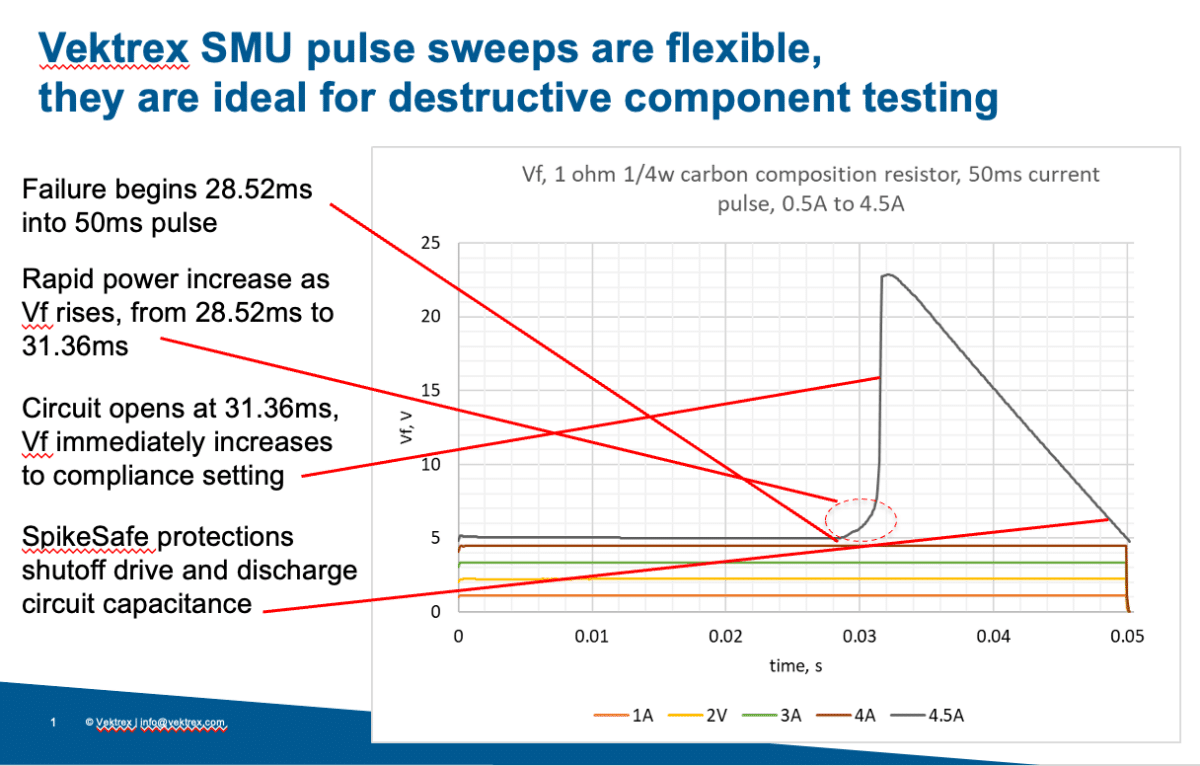
For devices like pyrobolts, the SMU can be used to verify the drive requirements to fire the bolt. Shown here is an overlay graph with the forward voltage across a 1 om resistor, when driven by 50 ms pulses of various amplitudes. As shown, the resistor, which is only rated at ¼ watt, is able to handle the pulsed current up to 4 A. But at 4.5 A (about 20 w) the component begins to fail 28.52 ms into the 50 ms pulse. Failure is complete (the resistor is blown) at 31.36 ms. The SpikeSafe protections then shut off drive and discharges the circuit capacitance.
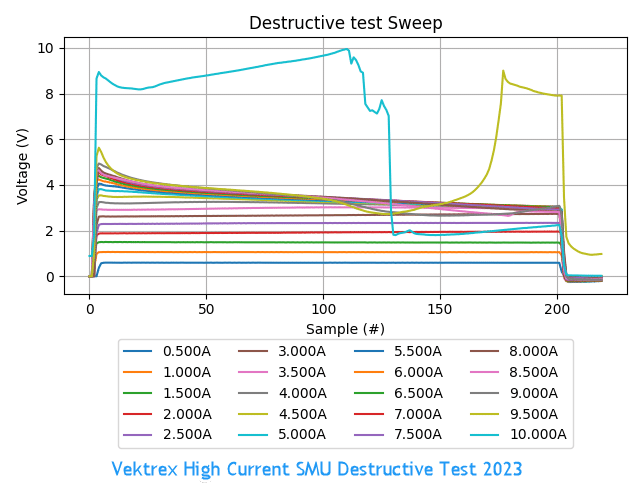
Voltage Limit Sweep to 10A
In this example, the SpikeSafe protections are set to limit voltage mode. In this case, the Vf remains at the maximum compliance setting after the circuit opens.
Laser failure detected with voltage limit
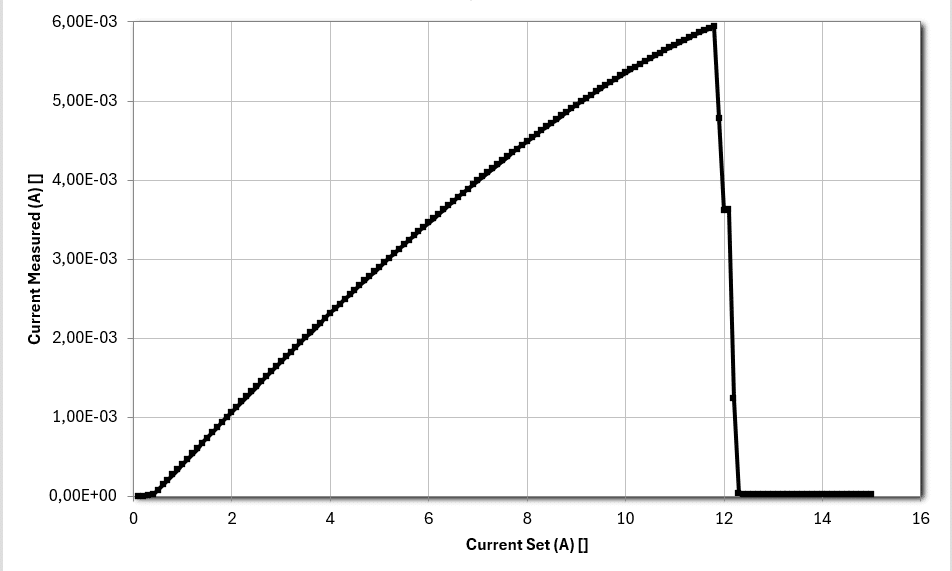
Compliance Voltage Limits with Vektrex SMUs
For more information on using compliance voltage limits with Vektrex SMUs, contact us. Our representatives will gladly answer your questions.
Click the button below to view our Source Measure Unit lineup.
